Sublime and uncanny politics: a critical reflection on Crisis Actor
Samantha Floreani
NB: This response contains spoilers for the show.
How can art respond to the polycrisis? For some, the aim is to provide a soft landing. For others, it looks the horrors straight in the eye. Ambitiously, Crisis Actor goes further: beyond observation into full, participatory experience. Blending social-experiment and live performance with digital interactivity, virtual reality and game design, writer and director, Vidya Rajan, digital artist Sam Mcglip and dramaturgist Andrew Sutherland have created a galvanising work that follows the absurd late-stage capitalist logic of experience-as-commodity under rising fascism to its brutal end. Months later, it continues to play on my mind. If cushy entertainment is what you’re after, this is not for you.
It begins with the creation of a shared memory: there has been a disaster and we are the survivors. Standing around an ominously-lit centrepiece, the crowd reads and responds to poetic evocations melting over our phones. A rhythm builds, the collective light of our screens pulse together, my breath quickens to match. From the outset, the audience is invited to participate in the speculative world we now share; we are not mere observers, we have skin in the game.
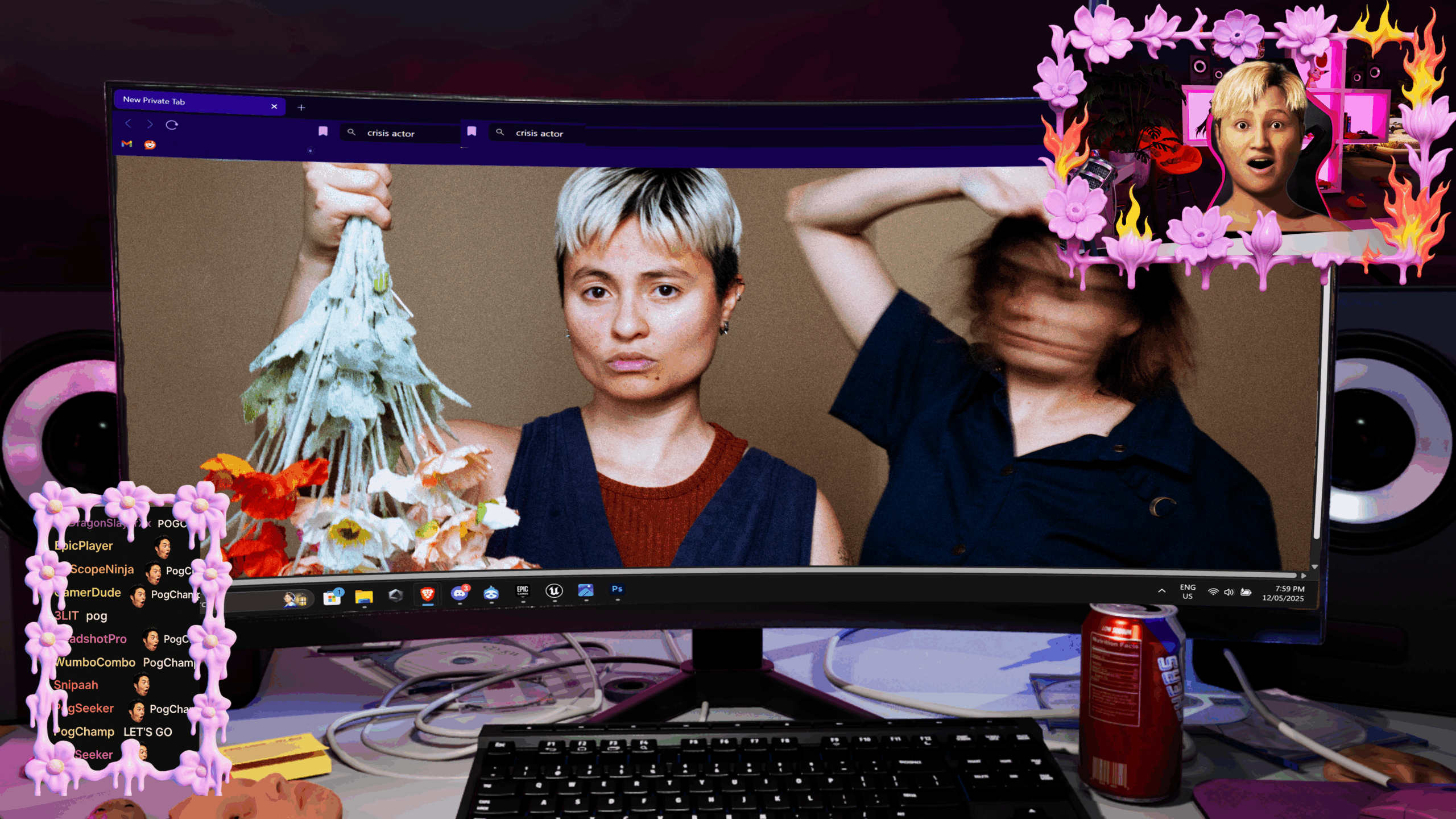
Welcome to the Crisis Haus, where contestants compete for your vote to become the next official spokesperson of ‘The Bloomening’. I’m assigned to Team Jean (led by Jean Bachoura) who pits their body, voice and emotion against Team Jess (led by Jess Nyanda Moyle). Jean and Jess move through each challenge by contorting themselves to the on-stage sensors to make their on-screen avatars attempt to elicit empathy and support from the audience who hold their fate, quite literally, in their hands. It is eerily reminiscent of the way people seek to render themselves legible to a digitally mediated audience under the attention economy. Through embodied performance translated to cyberspace, the metaphor of machine-readability is made visceral.
In this way, Crisis Actor both employs and critiques technopolitics to great effect. Through the hybrid layers of fleshy bodies and virtual identities, creative technologists Henry Lai Pyne, Ruby Quail and Quinn Franks and production designer Romaine Harper evoke the confounding experience of split-space. Where should one focus their attention? Do I look at Jean and Jess in their human form, right in front of us? Or at the big screen showing the virtual arena and the deranged game show host, Klaus? Or, at the chat livestream on the smaller screen to the side? Or, at the even smaller screen, right there in my lap? Rather than opting to control the audience’s attention, Crisis Actor lets it run wild, creating an embodied sense of capture, distraction, and gamification.
By turning our frayed attention and compassion fatigue against us, the artistic and technological innovation of Crisis Actor combines to make for a somewhat overwhelming experience — familiar to anyone who feels confounded by scrolling online through death, joy, destruction and mundaneity in quick succession. It’s also funny. Building on her previous work such as In Search of Lost Scroll and Respawn, Rajan is the master of cursed comedy. The ability to traverse seamlessly between playful chaos and political provocation is unmatched — we are laughing, we are crying. For instance, the designers’ use of simulated 3D avatars leaves me revelling in the silly sublime of the digital uncanny. By incorporating moments of pleasure to accompany the solemnity Crisis Actor takes us on an exorcising ride of tension and release. In this hypersensory onslaught, the bounds of medium unravel: the work of art becomes indistinguishable from its virtual representation and the tangible corporeality of the audience. The aesthetic experience pushes toward total engagement; everything simultaneously without pause or distinction; the spectator becomes ingested by the spectacle.
Despite the fun, Crisis Actor doesn’t let the audience off easy. Through its practice of exposure and extremity, it lays bare the brutalisation of the world as we know it and invites us to enjoy — and participate — in our own devastation. It is, as Anna Kornbluh diagnoses in Immediacy: Or, the Style of Too Late Capitalism, redolent of the current cultural compulsion away from mediation: everything is now, everything is urgent. The genre of immediacy, she argues, pushes towards a different function for entertainment: “not evasive delusion about but deeper enthrallment in the spectacle of mass abjection.” As the contestants perform their trauma, Crisis Actor invites us to reckon with the perils of confusing surveillance with self-expression, or mistaking confession as a tactic against the predations of a privatised cultural and media economy.
When you’re inundated with a constant stream of crisis-as-content, who do you become in the chat? As the Crisis Haus contestants compete, the audience takes to their keyboards: fiercely defending their champion and smashing the react button to send flower emojis bouncing into the virtual arena. Regardless as to whether Jess recounts their experience of bullying, or Jean monologues about the Armenian Genocide; jokes continue to fly fast and furious. For some reason, I find myself writing, “Klaus – smash or pass?” Next to me, a friend types, “Klaus, what that mouth do?” and hits send. We laugh, but later, we are disturbed by how quickly we morphed into a version of ourselves in the chat that we did not recognise.
Despite Jean’s emotive recount, the audience votes for Jess, who made us laugh through the crooked movements of their CGI avatar. Perhaps this shouldn’t be surprising, though it is. In a world where the marginalised must display their trauma to win their humanity, Crisis Actor critiques the cultural tendency to ascribe authenticity to suffering, enhanced by the digital platform logic of engagement as endorsement. Caught up in the spectacle, the audience adopts the role of the sadistic witness, our desire for entertainment and engagement become implicated in the horrors from which we are ostensibly removed.
Once the final votes have been cast, my phone flashes red: “STAY PUT” it says, “please wait your turn to evacuate as we prioritise more important evacuees.” Those on Team Jess are ushered into the next room. Here, the losers watch grimly as an unsettling video of bodies melding and convulsing plays. Jean collapses to the ground, slowly writhing amongst the lumpy forms that we now come to recognise as corpses of former losers. Behind the ominous soundscape, I hear the rapturous voice of Klaus next door as he praises the winners. They cheer, dance, laugh while we sit in the dark. On my phone, the Jean Archive slowly fades to black to free up collective digital memory space. The sound of them celebrating while we observe erasure in action is sickening.
Out in the foyer, a mix of exuberance and catharsis permeates the room. Another friend, who was assigned to Team Jess, recounts the distress of being cast as winner, despite not feeling in control of the outcome. This prompts me to reflect on how much power we, as the audience, had over the proceedings of Crisis Haus and its fascist leader, Klaus (and indeed, how much power we have over society through the formal mechanisms afforded to us). Were our votes arbitrary?
Through its employment of digital interactivity, Crisis Actor positions the audience as active participants, not passive witnesses — forcing us to confront our own complicity in the action. Yet it also reminds us of the powerlessness of digital voyeurism, despite the utopian dream of networked technologies as somehow democratising. We are provided with a sense of control that turns out to be yet another form of submission.
In his 2003 analysis of reality television and new media in The Work of Being Watched, Mark Andrejevic was early to the party in taking to task the champions of the digital revolution who espoused online interaction as a path to liberation. “The promise of interactivity as power sharing,” he writes, “threatens to reveal itself as a strategy for the rationalisation of politics and the mass-customised engineering of consent.” Rather, interactive media functions as a form of productive surveillance allowing for the commodification of experience as a product. The form of digital participation troubled by Crisis Actor is consistent with a model of political engagement that is limited to electoral politics and online self-disclosure.
Could the audience break the game; refuse to vote; organise in the chat to take down Klaus; revolt in their seats? The team behind Crisis Actor have stated that it is not rigged, that the flow, stories and ‘winner’ depends on the audience. Yet though the show differs every night, it is rigged, and that’s why it’s powerful. It’s rigged in the same way that the idealistic illusion of participatory democracy expressed through the logics of platform capitalism is rigged. Ultimately, we are left to grapple with the insightful possibility that perhaps there are no winners in the Crisis Haus; that its very construct is on notice. I only wish I could go again, have a do-over equipped with the hindsight that the future affords history, and meet the work where it is: in equal parts rapture and resistance.
Samantha Floreani is a digital rights advocate and writer based in Naarm. Their writing explores technology, power and social norms and has been published in The Guardian, Overland, Kill Your Darlings, and elsewhere. A long-term advocate for human rights in the digital age, they previously served as Head of Policy at Digital Rights Watch and are currently undertaking a Phd on housing injustice and the machine-readable renter. You can read more of their work at samanthafloreani.com
Image Credit: Gregory Lorenzutti
Image Description: A metal rig holding screens and an orb-like structure.